Madison Wan
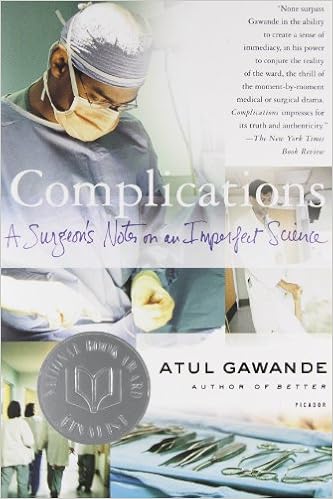
Complications: A Surgeon's Notes On An Imperfect Science
By Atul Gawande
Imagine being an intern for your local hospital. You're in the ER and your senior chooses YOU to perform the blood work. You're scared out of your wits and a number of things are running through your mind. What do you do and what should you consider? This is how Atul Gawande made his readers feel. If you haven't read his book Complications: A Surgeon's Notes On An Imperfect Science, sprint to the nearest Barnes & Nobles and read the book because he exemplifies the importance of being a physician and highlights the struggle of underrated doctors that have to face the angry people of today and the politics of their experiences in the medical field.
Atul Gawande, MD, MPH, is a general and endocrine surgeon, a writer, and a public health leader who practices at Brigham and Women’s Hospital in Boston. Having already done his time as an intern, resident, and attending, Gawande knows what he's talking about; his reality is our experience in the reading.
Having only read a portion of the chapters, I’m already blown away by the intensity Gawande drags you into. His writing is intriguing and insightful. Stories and small journals of his life are exposed. He makes his readers feel the adrenaline of literal life-death situations and takes you through his thought process, especially of what's at stake. Not only does he focus on the action in the ER, but Atul Gawande also reveals what ordinary people may not usually think about in terms of doctors: “like the tennis player and the oboist and the guy who fixes hard drives, we need practice to get good at what we do. There is one difference in medicine, though; it is the people we practice upon” (18). Lawsuits, stress about errors, telling family members of their loved one's complications and maybe even death is mentally challenging - situations not to be taken lightly. Imagine being a target for a lawsuit or failure every day as part of your job plus spending relentless hours in the hospital.
Credit to doctors is just as explained as the errors of doctors. Gawande remains humble and understanding and is not afraid to call out the flaws in the medical field or even his own career. One point he mentions is that “doctors are seldom outraged when the press reports yet another medical horror story. They have a different reaction: That could be me. The important question isn't how to keep bad physicians from harming patients; it's how to keep good physicians from harming patients” (57). Likewise, he opens up debates of the medical and public community. Both sides are appointed with reason, but Gawande also allows his opinion to be heard. After exchanging views on whether or not machines should be taking over the medical processes he subsequently advocates, “In the increasingly tangled web of experts and expert systems, a doctor has an even greater obligation to serve as a knowledgeable guide and confidant. Maybe machines can decide, but we still need doctors to heal” (46). Gawande's opinions are viable due to his expertise on the topic, and he becomes very philosophical. As a result, the reader is persuaded to be aware of his point of view.
Whether you're planning to have a career in the medical field or curious about the reality of our doctors, definitely read Atul Gawande’s book and his other books. It's fun, it's intense, it's didactic, and it's empathetic. As an aspiring doctor, I appreciate how Atul Gawande’s use of explanations and stories made my view a bit clearer into what the world of medicine is like - how scary, yet exciting it can be. Every part of the book was worth something knowing about or caring about. If you’ve read the book already and enjoyed the journey he put you through, read The New York Time’s article, “Go to the Wrong Hospital and You’re 3 Times More Likely to Die.” Like the title, the next hospital you go to may vary in their specialties and death rates, which could alter your chances in a successful procedure. Hospitals are all not alike and that’s what I feel Atul Gawande is trying to express with his book as well. However, mistakes are inevitable; they’re also an experience to learn and grow from.
Sources:
Gawande, Atul. Complications a Surgeon's Notes on an Imperfect Science. London: Profile, 2008. Print.
“About.” Atul Gawande, atulgawande.com/about/.
Abelson, Reed. “Go to the Wrong Hospital and You're 3 Times More Likely to Die.” The New York Times, The New York Times, 22 Dec. 2017, www.nytimes.com/2016/12/14/business/hospitals-death-rates-quality-vary-widely.html
Comments
Post a Comment